
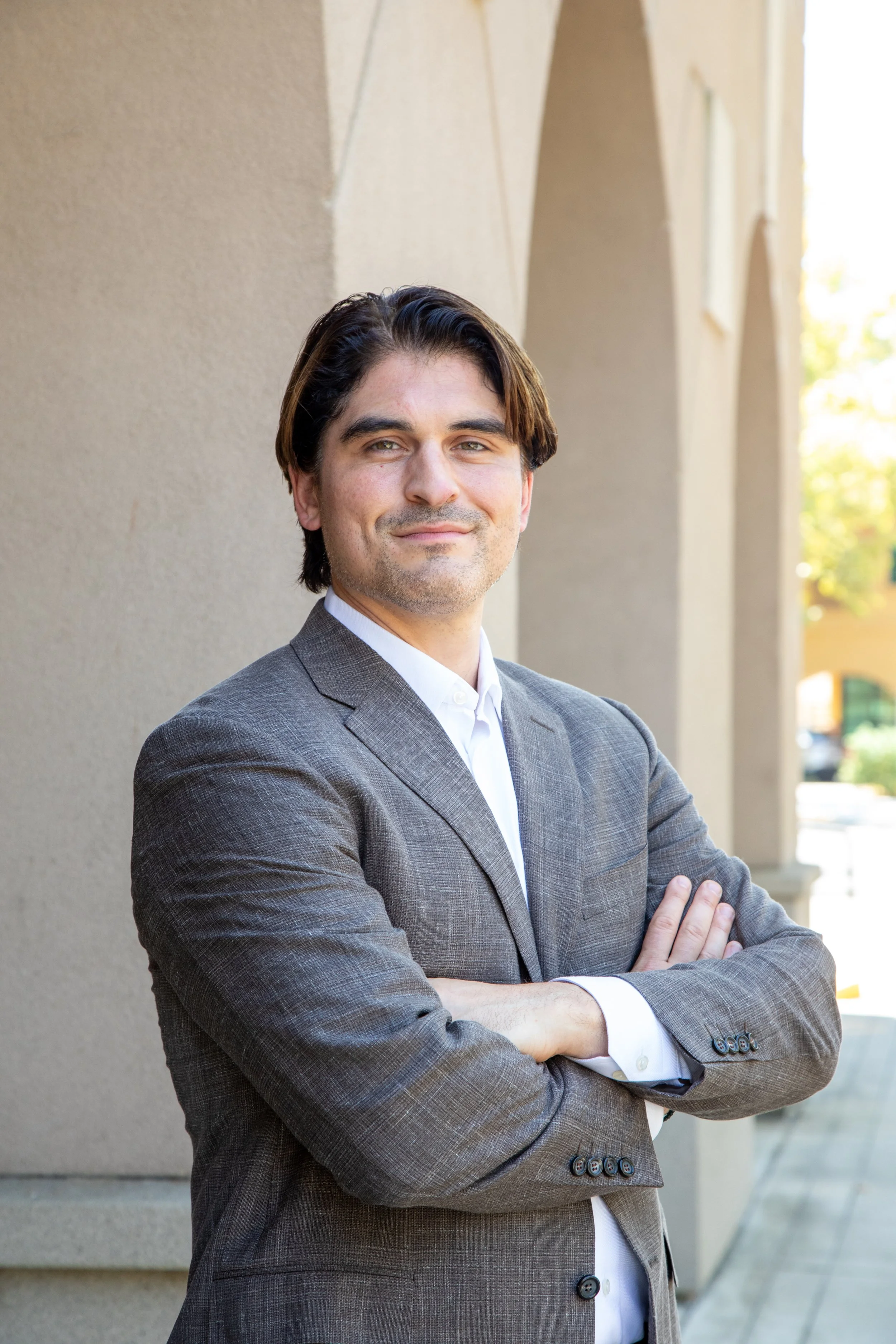
Eric as a Nonprofit Executive
“The Community Work
Before the Ballot”
Before I decided to run for office, and alongside my career as a business builder, I spent the last several years building and running charitable organizations.
My family relied on food stamps, on Medicaid, on disability checks, and on our church when I was growing up. Everything below comes out of that, one way or another. It's work I'd be doing whether or not I ever ran for anything.
The Rachel and Eric Jones Foundation
Rachel and I began our charitable giving in 2019 — expanding in-person tutoring and literacy programs, mostly. Helping kids from falling further behind during and after COVID was important to us.
We created the family foundation in 2021, and in 2025 we made it a full 501(c)(3), hired staff, and expanded the mission: women, children, families, veterans, and communities in Northern California.
Safe Seats. A car seat costs money a lot of young families don't have, and the consequence of going without one is a child in a crash. The foundation has put hundreds of thousands of dollars of free car seats into families' hands across Napa and the North Bay, working through the local organizations that already know who needs them.
Bonds of Sisterhood. Built with Nation's Finest, for women veterans — the fastest-growing part of the veteran population, and the one the services were never designed around.
Vacaville Community of Arts. The Journey Downtown theater was going to close. The foundation funded the nonprofit that saved it. It's open, and local schools use it as an auditorium.
Read On Sonoma. Literacy programming, which the foundation helped expand into more Sonoma County schools.
Why literacy
That last one is personal.
I grew up in a house that was hard to be in, and books helped me escape years before I could physically leave. When your house is hard, a book is the first place anybody shows you that somewhere else exists. Nobody had to buy me anything for that to happen — the library was free, and a teacher pointed me at it.
It's also why, when the schools shut down, I led an effort that raised more than $10 million to get low-income kids in Northern California real, in-person tutoring. The kids with somebody at home who had time and money kept learning. The kids who didn't, didn't — and that gap follows them for life. School and books were my way out. COVID was taking them from the kids who had the least.
The American Dream Institute
I founded and funded the American Dream Institute in 2024. It's a charitable organization, and its work is promoting free speech online and increasing civic engagement among young Americans.
The problem it was built for. A handful of companies know more about what Americans actually think than Americans do. Every platform collects it. None of them share it. They rent it back out to whoever can afford the price.
So the loudest and best-funded operations online know precisely what lands, and precisely who to aim it at. Everybody else is guessing in the dark.
That's how you get the internet we ended up with. The extremes get louder, because the extremes hold the data and the machinery to use it — and they grab your attention and make more money. The ordinary conversation gets quieter. Many stop saying what they think.
Creators' livelihoods depend on their audiences, so many are afraid to speak their mind and risk upsetting that livelihood.
That's a free speech problem, and it doesn't look like censorship. Nobody gets banned. People just go quiet, because they can't tell what a thing is going to cost them to say.
What ADI does about it. The organization gives creators the resources and the shared information to say what they actually think.
It brings creators into communities where they can connect with each other, and share their own anonymized audience data — musicians, comedians, gamers, people who make things for a living. Everyone opts in. Everyone keeps ownership of what's theirs. And it's all aggregated and anonymized, so individualized user data is not collected or shared.
A creator in that network can see how their own audience actually feels about something. What people care about. What's safe to bring up. Where the real disagreement sits, instead of the disagreement an algorithm decided to reward.
Give somebody that and they talk about more things, not fewer. More speech, from more people, with better information about who they're talking to.
ADI also asks directly. We've polled thousands of young Americans, to contribute to that shared information ourselves.
The Rachel and Eric Jones Foundation and the American Dream Institute are independent 501(c)(3) charitable organizations. Neither is affiliated with, controlled by, or operated for the benefit of Eric Jones for Congress or any political campaign, and neither supports or opposes any candidate for public office. Nothing on this page is a solicitation for either organization.