
PRIORITIES • Protect Our Future • Policy to
Protect Our Land and Family Farms
Why I believe this — and how I’ll fight for it.
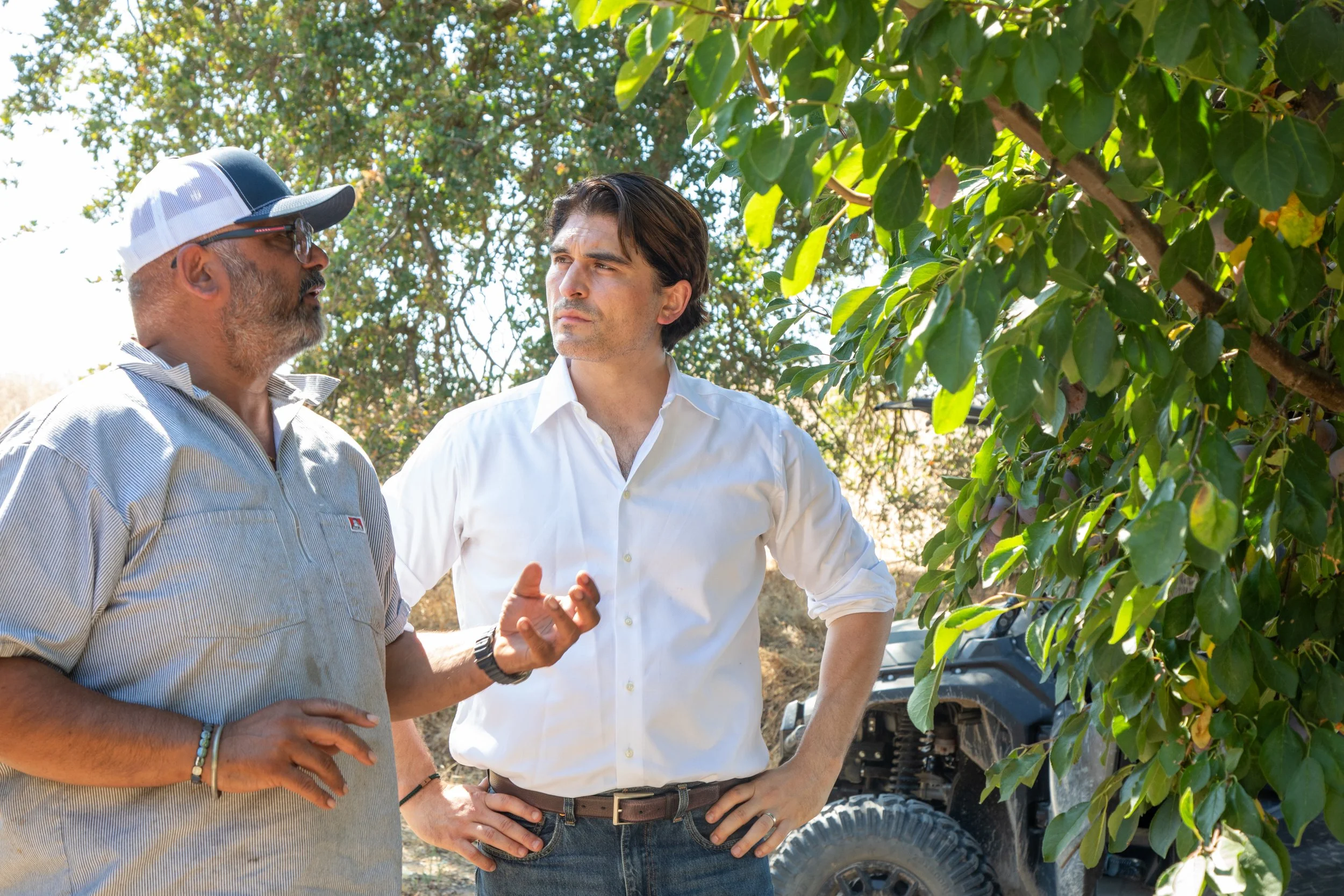
I grew up in an agricultural town, so I know a family farm is more than a business — it’s a family’s whole life, built over generations, and it’s the heart and soul of this district. The people who work this land feed the country and hold our communities together. But right now, that way of life is being bought out from under them.
Here’s how it happens, and it’s the same rigged game you see everywhere else. The biggest agricultural corporations fund the politicians and hire the lobbyists, and they make sure the rules get written for them. A regulation that’s a rounding error for a corporate mega-farm is a ruinous cost for a family operation. Pile enough of them on, and the small farm can’t keep up — so it gets priced out, squeezed, and finally forced to sell. And who’s waiting to buy? The same operations, and foreign investors, gobbling up our land parcel by parcel.
We’re watching it happen right now in the Napa Valley. Some of the biggest wineries and foreign buyers — with the establishment clearing the way at the state and local level — have made it so expensive for a small family winery to survive the fines, the fees, and the red tape that many have no choice but to sell to a corporation or an overseas investor. And this was never just about wine — it’s the same squeeze on family orchards, row-crop growers, and ranchers across this district and up and down the state. It’s spreading, and it’s heading deeper into the Sacramento Valley — Yolo, Colusa, Sutter, Yuba — unless we stop it. Our own representative has watched it happen and done nothing. I won’t.
Here’s what I’ll do — and why
Break the corporate stranglehold on agriculture. The heart of this is consolidation — a handful of giant corporations controlling more of our food, our land, and our markets every year. I’ll fight to enforce real antitrust law in agriculture, break up the monopolies that squeeze family farms on both ends — what they pay for supplies and what they get for their crop — and stop writing regulations that are pocket change for the giants and ruinous for the small. When the rules stop being rigged for the biggest players, a family farm can actually compete again.
Stop the corporate and foreign buy-up of our farmland. Our farmland should belong to the families who work it, not to corporations and foreign investors treating it as an asset to flip. I’ll fight to limit the corporate and foreign buy-up of American farmland and vineyards, and to give local farmers the first shot at land that comes up for sale — so the next generation can keep farming here instead of watching outside money price them out.
Deliver fairer subsidies and estate-tax relief — so farms stay in the family. Today, farm subsidies flow disproportionately to the biggest operations, the ones that need them least. I’d rebalance them toward the small and mid-sized family farms that actually need the support to survive. And I’ll fight for estate-tax relief for family farms, so that when a parent passes, the children don’t have to sell the land just to pay the tax bill. No family should lose the farm at the very moment they inherit it.
Incentivize regenerative agriculture — good for the farmer and the land. This is where pro-farmer and pro-environment stop being opposites and become the same thing. I’ll fight to incentivize regenerative agriculture — farming that rebuilds the soil instead of stripping it — with incentives strong enough to actually be worth a farmer’s while: payments and tax credits that put real money back in your pocket for the carbon you put back in your ground. Done right, it holds water in the soil so you buy less of it, cuts the fertilizer and chemical bills that eat your margins, and makes crops more resilient when the next drought hits — so your costs fall and your land is worth more when you hand it to your kids. And when our farms hold water and grow more with less, everyone downstream pays less for water and food too. Healthier land, lower costs for the farmer, savings for every family, all at once. There’s no trade-off here. It’s proof farmers and the environment were never really enemies.
And keep our open country open. The working land and wild spaces of this district are part of what makes it worth calling home. I’ll fight to conserve the open land and natural beauty our kids should inherit — so the next generation grows up with the same room to roam, clean air, and living landscapes we did.
What this means for Our District
Family farms and vineyards are the heart and soul of this district — from the vineyards of Napa and Sonoma to the orchards and row crops of the Sacramento Valley. The small growers, the family wineries, the people who’ve worked this land for generations: they are what makes this place great. And every level of the establishment is letting them get crushed.
It’s happening on purpose. The unfair rules that bleed a small winery dry — the fines, the fees, the endless red tape — don’t come from nowhere. They’re backed by the establishment at every level, and left unchallenged by our own congressman in Washington. A regulation a corporate giant absorbs without blinking is the one that breaks a family operation — and that’s by design. Squeeze the small until they have to sell, then let the corporations and foreign investors buy them up.
For decades, these nine counties have not had a representative who fights for small business and small agriculture. We’ve had representation that sided with big agriculture and the corporate interests that bankroll it — while the small farmers who are the backbone of this place were left to fend for themselves. That has to end. We need someone who actually favors small ag, who knows how much it matters to this district, and who isn’t beholden to the big businesses that bend the rules against it. I don’t take a dime of their money — so I can be that someone. I’ll answer to the family fighting to hold onto the farm, and take on the establishment at every level, local, state, and federal, that’s been rigging the rules against the very people who are the heart and soul of this district.
The bottom line
Land is legacy. A farm passed down through generations, open country your kids can grow up in, food grown by people who actually live here — that’s what makes this district what it is, and it’s worth fighting for. Stand up to the corporate consolidation, keep our farmland in local hands, invest in farming that heals the land instead of depleting it, and we hand our children a district that’s still theirs. Let’s keep it that way.
SOURCES
Federal farm program payments have long been concentrated among the largest operations: GAO — “Farm Programs: Direct Payments Should Be Reconsidered,” GAO-12-640